
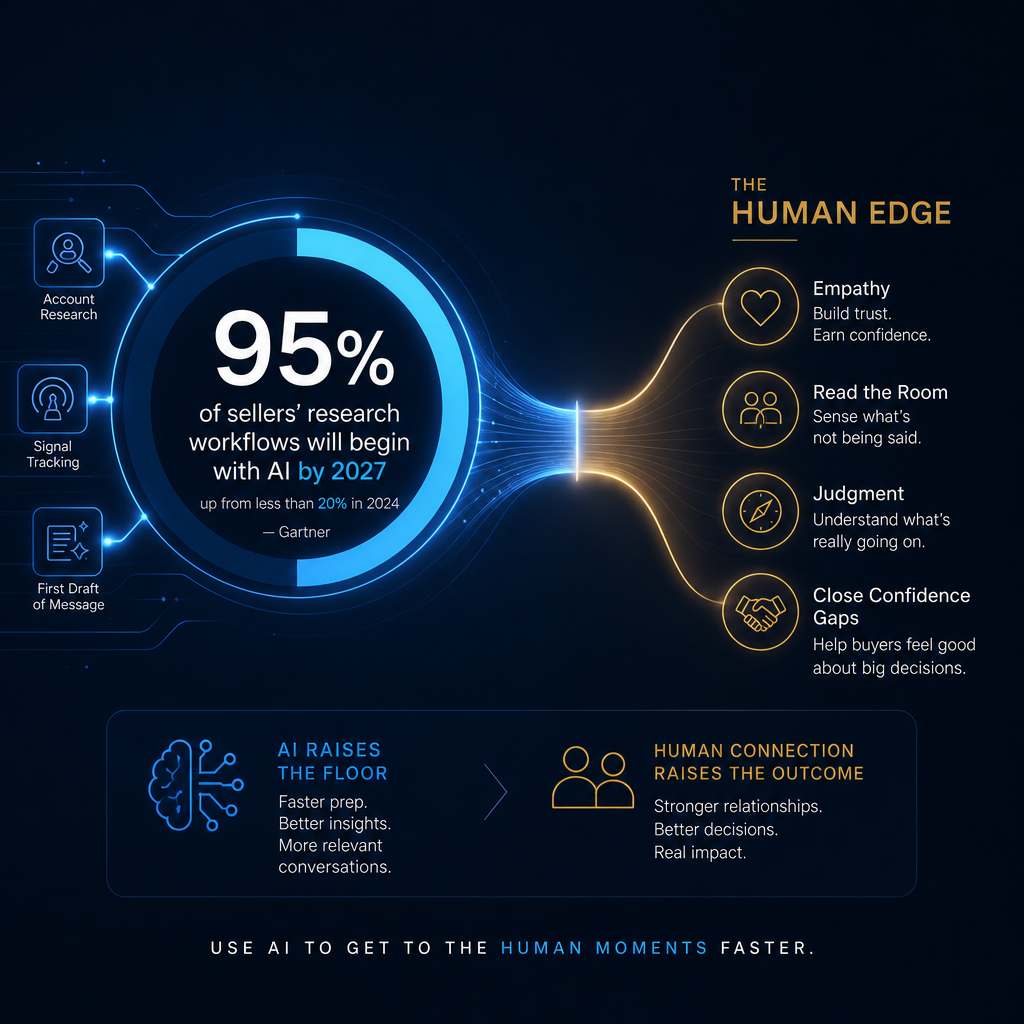
Gartner predicts that by 2027, 95% of sellers’ research workflows will begin with AI, up from less than 20% in 2024.
I read that number and smiled. For more than twenty years, I have stood in front of sales teams and said a version of exactly this: do your homework before the call, know what the other person cares about, and show up relevant. The work that used to eat an afternoon of digging through search engines, news archives, and filings now takes an AI a few seconds.
Sales intelligence is understanding a prospect’s company, their issues, their competitors, and their personal priorities before you ever ask for their time. Gartner’s prediction simply industrializes the slow half of that equation.
Twenty years of telling people to do their homework
Warm calling built on preparation works, and it always has. The reason it stayed rare was that research took too long, forcing people under quota pressure to skip it and just dial.
That excuse is gone. When preparation costs seconds instead of an afternoon, everybody gets to show up prepared. Preparation stops being a differentiator and becomes the entry fee.
Here is what a prepared call is worth when someone actually does it: Anthony J. Parr, CFP, a managing director of investments at a major brokerage firm, noted that after his team put these methods to work, it gave them a “HUGE edge and lots of confidence.” They landed a significant new account. The research got him in the room. What closed the account was the conversation once he was there.
The buyer numbers say the human half got bigger
The same Gartner study surveyed 645 B2B buyers, and the findings point in one clear direction. Compared with generative AI, buyers were:
- 39 percentage points more likely to say a human rep understood their needs.
- 32 percentage points more likely to say a rep made them feel confident in their decision.
- 28 percentage points more likely to say a rep helped them advance to the next step.
Those three numbers sit right next to that 95% prediction. Machines are about to own the front end of the sales process almost completely, yet the thing buyers still credit humans with happens after the research is done. It’s reading the room, hearing the fear underneath a stated requirement, and closing a confidence gap so a person feels good about signing something large.
I have framed this for years as being interesting versus being interested. Being interesting is now easy, and AI just made that table stakes for every competitor you have. Being interested means knowing a buyer’s goals, fears, and care-abouts, and actually caring about the answers. AI hands you the inputs for caring, but the caring itself stays with you.
What should sales teams hand to AI first?
Hand over the work where the output is a fact, a draft, or a pattern. Keep the work where the output is a judgment. In practice, that means four things:
- Account and person research. Company news, leadership changes, earnings commentary, expansion announcements, litigation, industry pressure. These are the three lenses I teach: person intel, company intel, and industry intel. AI compresses hours of it into a clean briefing—just make sure it cites sources so you can verify them.
- Trigger and signal tracking. A demographic fit is just a suspect. Something happening in their world (a relocation, a new product launch, a new CEO) turns that suspect into a prospect worth calling today. Monitoring those events across a few hundred accounts is machine work; a human doing it by hand will always be late.
- The first draft. Use the draft to refine, not to send blindly. Make the 70/30 rule work: 70% of what you say should be about them, their business, and their industry, and no more than 30% about you and your solution. AI is great at holding that ratio when instructed. Most reps, left alone with a blank email, are not.
- Better questions. This is the one almost everyone misses. Use what you find to build a question you couldn’t have asked otherwise, rather than just reciting a fact back to them. “I see your biggest competitor is entering the new widget market. What do you think about that?” beats anything you could simply state at them.
What stays with you: deciding which twenty accounts deserve real attention this month, reading who in the buying group is nervous, making the call on when to slow a deal down, and owning every word that leaves your outbox.
Where this breaks: end-to-end automation
The failure mode I see most often is a team wiring research, drafting, personalization, and sending into one unbroken chain, then measuring success by volume with zero human review. The system technically runs, while the brand quietly erodes—one slightly wrong, slightly creepy, slightly generic email at a time.
Research should humanize selling. Overusing what you find reads as stalking. A human being looking at the message before it ships is the only way to tell the difference between a relevant detail and an unsettling one.
There is also a math problem with full automation. When the entire market can generate a personalized-looking email in four seconds, personalized-looking emails stop working. Doing the real work becomes the advantage again.
The last stretch is always a person
AI gets you most of the way there fast, but the final stretch belongs to a human every time: the judgment, the voice, the read on whether this particular message to this particular buyer on this particular day is right. That final review is a permanent design choice, not a temporary limitation waiting for the models to fix.
None of that happens by accident. Gartner found that organizations prioritizing AI upskilling for sellers were 2.4 times more likely to post strong revenue growth. This tracks with what I see in the field: buying licenses is vastly different from training, and the teams getting real results are teaching everyone, not just the leaders.
AI raises the floor on preparation for everyone, including your competitors, handing back hours of time. The only question that matters is what you spend that time on.
I would spend it on the buyer.