
A question came into our Certified AI 360 site form recently, and it stopped me because I’ve heard some version of it dozens of times over the last few years: “Does it make sense to train leadership on AI first and figure out the rest of the staff later?”
It’s a fair and honest question. It’s also the wrong call, and I say that gently, because it’s quietly costing the good people who make it.
The worry underneath the question is almost never about org charts. It’s about the rabbit hole. That very human fear that AI becomes a shiny distraction pulling people away from their actual jobs, so the safe move feels like containing it at the top, letting the leaders “get smart” first, and rolling it out to everyone once it’s controlled and understood. I genuinely get the instinct. I just think it produces the opposite of what you’re hoping for.
AI is a doing tool, and leaders don’t do the doing
Here’s the thing most owners miss about where AI actually earns its keep. It lives in the work. Writing the proposal. Answering the customer email that came in at 4:55pm. Scheduling the jobs for next week. Building the spreadsheet nobody wants to build. Personalizing the follow-up so it reads differently from every other vendor’s follow-up.
Your leaders, by design, aren’t the ones doing most of that, and that’s not a knock on them. So when you train only the corner office, you’ve trained the people furthest from the work that AI transforms fastest. The customer service rep is the one drowning in repetitive replies. The bookkeeper is the one running the same half-day report every month. The salesperson is the one staring at a list of names, starting at “A,” hoping someone eventually buys. Those are the people whose day changes the moment they learn the tools. And they’re the ones who come up with the ideas leadership never would, because leadership doesn’t sit in that seat.
I’ve said for years that the goal in sales is to be genuinely interested and relevant to what the other person cares about. AI training is that same principle turned inward. If you want it to matter, put it where the actual work and the actual customers live, right alongside the people who care about them most.
What “train the leaders first” actually buys you
Play it out and the pattern is remarkably consistent, and honestly, it’s one I have a lot of sympathy for. The owner gets excited. Attends a webinar, maybe a conference session, comes back energized. The knowledge stays parked at the top. Six months later, the leaders are “informed,” everybody nods in meetings about how important AI is, and the work is exactly the same as it was before the webinar.
You end up with executives who have a vision, staff still doing everything the old way, and knowledge that has nowhere to go. Call it what it is. A bottleneck.
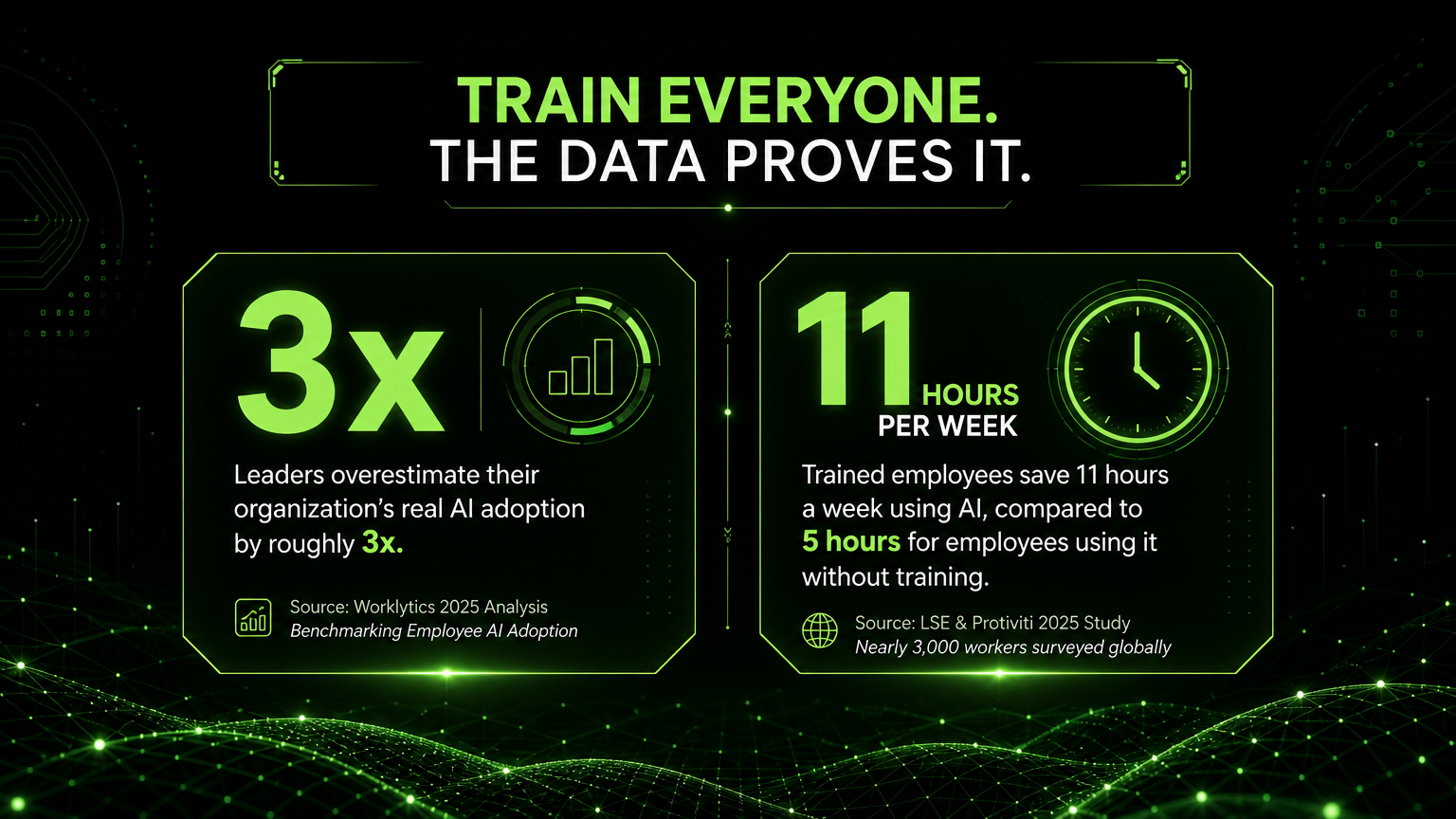
The data backs up how common this trap is, and it’s more human than embarrassing. Leadership tends to badly misjudge what’s actually happening on the ground. One 2025 analysis found that leaders overestimate their organization’s real AI adoption by roughly 3x (https://www.worklytics.co/resources/benchmarking-employee-ai-adoption-closing-gap-leadership-estimates-2025). Read that number the right way. It means a lot of good, well-meaning executives believe AI has taken hold across their team when the reality is a fraction of what they think. Training the top and hoping it trickles down is exactly how you get a 3x gap between the story you tell yourself and what your people actually do all day.
The businesses getting this right train everyone, and it shows up in output
The companies pulling ahead do the reverse of the containment instinct. They give the whole team access and the confidence to try, and then they get out of the way and let the results come from unexpected places. There’s a real payoff to it, and it’s measurable. A 2025 study from the London School of Economics and Protiviti, surveying nearly 3,000 workers globally, found trained employees save 11 hours a week using AI, compared to 5 hours for employees using it without training. That’s not a small edge. That’s more than double, and it’s the whole argument in one number. The return doesn’t come from access. It comes from trained people using AI in the flow of their actual work.
A few things I’m stubborn about
I don’t hand these out as a tidy checklist. They’re the beliefs I’ll gladly argue with any owner who tells me they want to keep AI upstairs a while longer.
You’re trying to give people enough confidence to try. Nobody on your team needs to become a prompt engineer, so let that pressure go. A handful will run with it, become the informal champions, and pull the rest of the team along behind them. That peer momentum does more than any mandate from the top ever will.
Culture is doing more work here than you think. Train only the leaders and the unspoken message your team hears is that AI is happening to them, decided above their heads, rolled down when the bosses are ready. Train everyone and the message becomes something warmer: we trust you, we’re equipping you, you’re part of this. In a moment when a real chunk of workers are quietly anxious about what AI means for their jobs, that reassurance matters more than the software.
Let your department heads set guardrails rather than play gatekeeper. There’s a real difference. A gatekeeper controls who gets to touch the tools and slows everyone to the pace of one nervous approver. A guardrail-setter gives the broader team access, then defines the focus, the priorities, and the timing so the effort points somewhere useful. Give people the keys. Ask the leads to set the destination and the speed limit, then trust everyone to drive.
This is now the entry fee.
For a while, using AI well was a way to get out ahead of the competition. That window is closing fast. Small business adoption jumped from 40% to 58% in a single year, and the gap between small firms and large enterprises is narrowing faster than any technology cycle before it. When your competitors down the street are all doing this, doing it yourself stops being an advantage and becomes the price of staying in the game.
Which is exactly why the top-only approach is so expensive, and I don’t say that to scare anyone. Every month your knowledge sits parked in the corner office is a month your team keeps working the slow way while the businesses around you get faster, more relevant, and more responsive to the same customers you’re all trying to serve.
So train the people doing the work. That’s where the friction is, that’s where the ideas come from, and that’s where the return actually lives. The folks at the top setting a vision they can’t personally execute won’t get you there. The rep, the bookkeeper, and the salesperson putting it to work every day will, and they’ll surprise you.
If you’re deciding right now who to train first, my answer is simple. Everybody. Start with the people whose Monday it will actually change.